
The Newmarket real estate market is heading into fall 2026 with an interesting combination of softer prices, fewer new listings and continued uncertainty around interest rates.
For buyers, this has created opportunities that were difficult to find during Newmarket’s highly competitive markets of previous years. For sellers, however, today’s market requires a much more thoughtful approach to pricing and presentation.
And there is another factor that could influence where the Newmarket housing market goes next: interest rates.
Newmarket Real Estate Market — August 2026
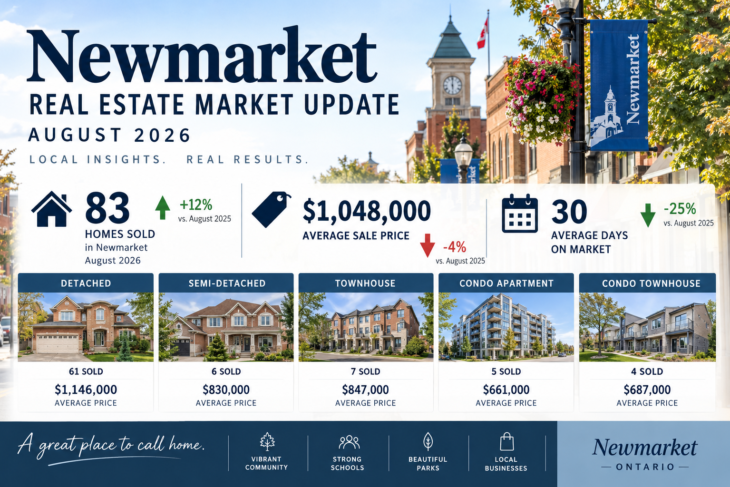
August recorded 83 home sales in Newmarket, with an overall average sale price of approximately $1.048 million.
Detached homes continued to account for most of the activity, with 61 detached properties selling at an average price of approximately $1.146 million.
Other Newmarket property types included semi-detached homes averaging approximately $830,000, townhomes around $847,000, condo apartments around $661,000, and condo townhomes around $687,000.
Homes were taking approximately 30 days to sell on average.
These figures show why it’s important not to look only at the overall Newmarket average. A detached home in Stonehaven or Glenway can behave very differently from a townhouse in Woodland Hill or a condo near Yonge Street.
The GTA Market Is Giving Us Another Important Signal
Newmarket is its own local market, but broader GTA trends often influence what happens here next.
According to the Toronto Regional Real Estate Board’s August Market Watch, GTA REALTORS® reported 5,057 sales in August 2026, down 2.1% compared with August 2025.
The more interesting number may be new inventory.
Only 12,075 new listings came onto the market, representing a significant 14.1% year-over-year decline. The GTA average selling price was $993,410, down 2.7% from a year earlier, while the MLS® HPI Composite benchmark declined 4.5%.
TRREB’s interpretation was that declining inventory could eventually create more competition between buyers if the trend continues.
For Newmarket, that’s something worth watching closely this fall.
What About Interest Rates?
This may be one of the biggest questions for Newmarket buyers right now.
On September 2, the Bank of Canada held its overnight policy rate at 2.25%. The Bank said inflation had recently been hovering around 3%, largely because of higher gasoline prices, while inflation excluding gasoline was 2.2% in July.
There is also more uncertainty than there was earlier in the year. The Bank pointed to elevated energy prices and new U.S. tariffs and Canadian countermeasures as risks that could add to inflation. Its September deliberations said policymakers were increasingly attentive to the possibility that inflation pressures could spread more broadly.
Recent reporting from Reuters reinforces that uncertainty. The Bank has indicated that it is prepared to adjust monetary policy if inflation remains persistent, while trade tensions and higher energy costs are complicating Canada’s economic outlook.
So buyers shouldn’t necessarily assume that substantially lower borrowing costs are just around the corner.
The Bank of Canada’s next scheduled interest-rate announcement is October 28, 2026.
How Could Interest Rates Affect Newmarket Real Estate?
Interest rates affect real estate primarily through affordability and buyer confidence.
When borrowing costs decline, the monthly payment on a given mortgage generally becomes more manageable. That can allow some buyers who were previously sitting on the sidelines to qualify for a mortgage or feel comfortable beginning their home search.
In a market like Newmarket, that matters.
If borrowing costs ease while the number of homes available for sale also declines, more buyers could end up competing for fewer desirable properties.
That doesn’t mean Newmarket prices will suddenly jump. Employment, consumer confidence, economic growth, inventory and the broader GTA market will all matter.
But rates and inventory are two of the biggest numbers we will be watching through the remainder of 2026.
Is This a Good Time to Buy a Home in Newmarket?
There isn’t one answer for every buyer.
What today’s market does offer is choice and negotiating opportunity in certain segments.
Some properties are sitting longer than sellers expected. Some have undergone price reductions. And buyers can often take more time to investigate comparable sales, arrange financing and evaluate a property than they could during the peak bidding-war years.
But good properties can still attract attention quickly.
Rather than trying to perfectly time the bottom of the market or the next Bank of Canada decision, buyers should look at the individual opportunity.
For example, if a home that meets your needs is priced appropriately and you can comfortably afford the mortgage at today’s rates, waiting solely because rates might decline can carry its own risk—particularly if lower rates eventually bring additional buyers back into the market.
What Should Newmarket Sellers Know?
The days of putting almost any property on MLS® and expecting multiple offers are behind us—for now.
Today’s Newmarket buyer is more selective.
That makes pricing, preparation and marketing extremely important.
Homes that show well and are priced according to current comparable sales have a much better opportunity to attract serious buyers. Homes priced according to what sellers wish the market was doing can spend weeks on the market and eventually require reductions.
Sellers should also pay close attention to their immediate competition.
A detached home in Stonehaven-Wyndham isn’t competing with every house in Newmarket. It’s primarily competing with similar homes in comparable neighbourhoods and price ranges.
The same applies to homes in Woodland Hill, Glenway Estates, Summerhill Estates, Armitage, Central Newmarket and Huron Heights.
What Could Happen to the Newmarket Market This Fall?

There are a few competing forces.
Prices have softened from previous levels, improving affordability for some buyers. At the same time, GTA new listings fell substantially year-over-year in August. Interest rates are well below the peaks seen earlier in this cycle, but inflation and global economic uncertainty mean the future path of rates isn’t guaranteed.
That makes the September-through-November market particularly important.
If inventory continues to decline while buyer activity remains relatively stable, the negotiating advantage buyers have enjoyed could begin to narrow for the most desirable homes.
If economic uncertainty instead keeps buyers cautious, properties that are overpriced may continue to take longer to sell.
That’s why we wouldn’t describe Newmarket simply as a “buyer’s market” or “seller’s market.” The conditions can be very different depending on the neighbourhood, price range and type of home.
Check our recent blogposts:
Newmarket vs Aurora vs East Gwillimbury: Where Should You Move?
Best Neighbourhoods in Newmarket (And How They Feel)
Buying a Home in Newmarket Under $1 Million: What Buyers Should Expect in 2026
Thinking about buying or selling in Newmarket, Aurora, or East Gwillimbury? We be happy to walk you through what these trends mean for your specific street or price range — reach out any time.
Nikolay & Tatiana Klyushkin
Nikolay & Tatiana Real Estate Team
Right At Home Realty Investments Group Brokerage
Serving Newmarket, East Gwillimbury & surrounding York Region communities